New EU Study: Where Manufacturers and Authorised Representatives Really Stand on MDR and IVDR
New EU study finds 48% of manufacturers have withdrawn devices from the market. Key MDR/IVDR and AR findings for 2026. Read the numbers now.
MedNet EC-REP
Author

On 1 July 2026, the study team behind the European Commission's "Study supporting the monitoring of availability of medical devices on the EU market" published the results of its third survey of economic operators. Manufacturers, Notified Bodies and Authorised Representatives of medical devices and IVDs were surveyed, with a data status of 31 October 2025.
The study is commissioned by the Directorate-General for Health and Food Safety (DG SANTE) through the European Health and Digital Executive Agency (HaDEA) and carried out by a consortium led by the Austrian National Public Health Institute (Gesundheit Österreich GmbH, GÖG).
213 of 216 responses received were considered for the analysis, 81% of them from EU-based manufacturers and 19% from manufacturers based outside the EU. Anyone weighing these figures against their own situation should keep that split in mind. This is already the third survey wave of its kind, following a first survey in 2023 and a second in 2024, which allows developments to be compared directly over time.
Where Medical Devices Stand: Progress, but at a Cost
The share of manufacturers with a written agreement in place with a notified body has risen sharply: from 67% (2023) to 90% (2024) and still 90% in the current survey. For most manufacturers, this first formal step is now in place, though the technical documentation work that follows remains substantial.
At the same time, the study reveals a striking figure: 48% of surveyed manufacturers (73 of 152) have withdrawn at least one product from the EU market since 2021. Among those affected, 63% cite product revenue not justifying the cost of MDR re-approval as the reason. Other reasons mentioned include products at the end of their life cycle, low sales volumes and low profitability. One manufacturer separately reported that for a specific class III product (bioabsorbable orthopaedic fixation screws and plates), there simply was not enough clinical data across all combinations of indications and patient groups, and that the effort required was disproportionate to the product's revenue.
The certification costs captured by the study offer a partial explanation for these figures. For preparing the clinical evaluation, manufacturers report a median cost, depending on risk class, ranging from around 10,000 euros (class I) to 50,000 euros (class III). For the total cost of an initial product certificate (across all classes, without a breakdown by risk class), the average sits at around 195,000 euros, with a median of 100,000 euros and a very wide spread among individual responses.
Timelines also remain long: 59% of notified bodies and 25% of manufacturers report that issuing a QMS certificate takes 13 to 18 months. For combined QMS and product certificates, 54% of manufacturers report more than 19 months.
Where IVDs Stand: Visible Improvement, but Not There Yet
For in vitro diagnostics, the study actually shows a positive trend. The share of IVD manufacturers whose certified quality management system covers their entire product portfolio has risen from 37% (2023) to 38% (2024) to 47% in the current survey. Conversely, the share of manufacturers with no IVDR-compliant QMS at all (neither certified nor in the certification process) has fallen over the same period from 28% to 20% to 10%.
Progress is clearly visible, even though not every manufacturer has reached the finish line: only 49% of manufacturers have had first products certified under the IVDR, with a further share still in the certification process. Worth noting: the study reports somewhat less granular data for IVDs overall than for medical devices, in particular there is no cost breakdown by IVD risk class comparable to the one available for medical devices.
Among the IVD-specific reasons for discontinuing products, manufacturers cited a lack of agreement with the distributor and, in one case, a manufacturer's outright decision to no longer pursue IVD activities going forward.
What the Study Reveals About Authorised Representatives
For Authorised Representatives themselves, the study includes a dedicated section with 36 responses. Two findings stand out in particular.
Of the ARs surveyed, 56% are organisationally part of a manufacturer, while 44% are independent, third party ARs, the model MedNet EC-REP operates under. Most ARs manage a manageable client portfolio: 20 of 36 ARs report representing fewer than 10 clients, and only 2 ARs represent more than 500. MedNet EC-REP was itself among the survey respondents in this category.
Also notable is the limited visibility many ARs have into their own clients' IVDR transition status. 20 of 36 ARs could only answer "don't know" when asked what percentage of their clients had completed the IVDR transition. The picture for MDR transition is somewhat clearer, though still spread unevenly.
Conclusion
The third wave of the EU study paints a nuanced picture. For medical devices, the structures (written agreements, certification processes) have largely settled in, even though costs and timelines remain high and nearly one in two manufacturers has withdrawn products from the market as a result.
For IVDs, the data shows clear improvement over previous years, even though roughly half of manufacturers still have to complete the certification process. For Authorised Representatives, the study also shows that many have only limited visibility into their own clients' transition status, a point where closer collaboration between manufacturer and AR can make a real difference.
Not sure where your company stands on MDR or IVDR implementation?
As your Authorised Representative, we keep track of your certification status and next steps. ⇨ Explore Our Services
Sources
European Commission, DG SANTE/HaDEA, "Study supporting the monitoring of availability of medical devices on the EU market," presentation on the 3rd Economic Operator survey (data status 31 October 2025, published 1 July 2026): health.ec.europa.eu
Related Articles
IVDR Rule 7: When Is IVD Control Material Class B? (MDCG 2020-16 Rev. 5)
MDCG 2020-16 Rev. 5 clarifies when IVD control material without an assigned value falls under class B, and when another rule applies.
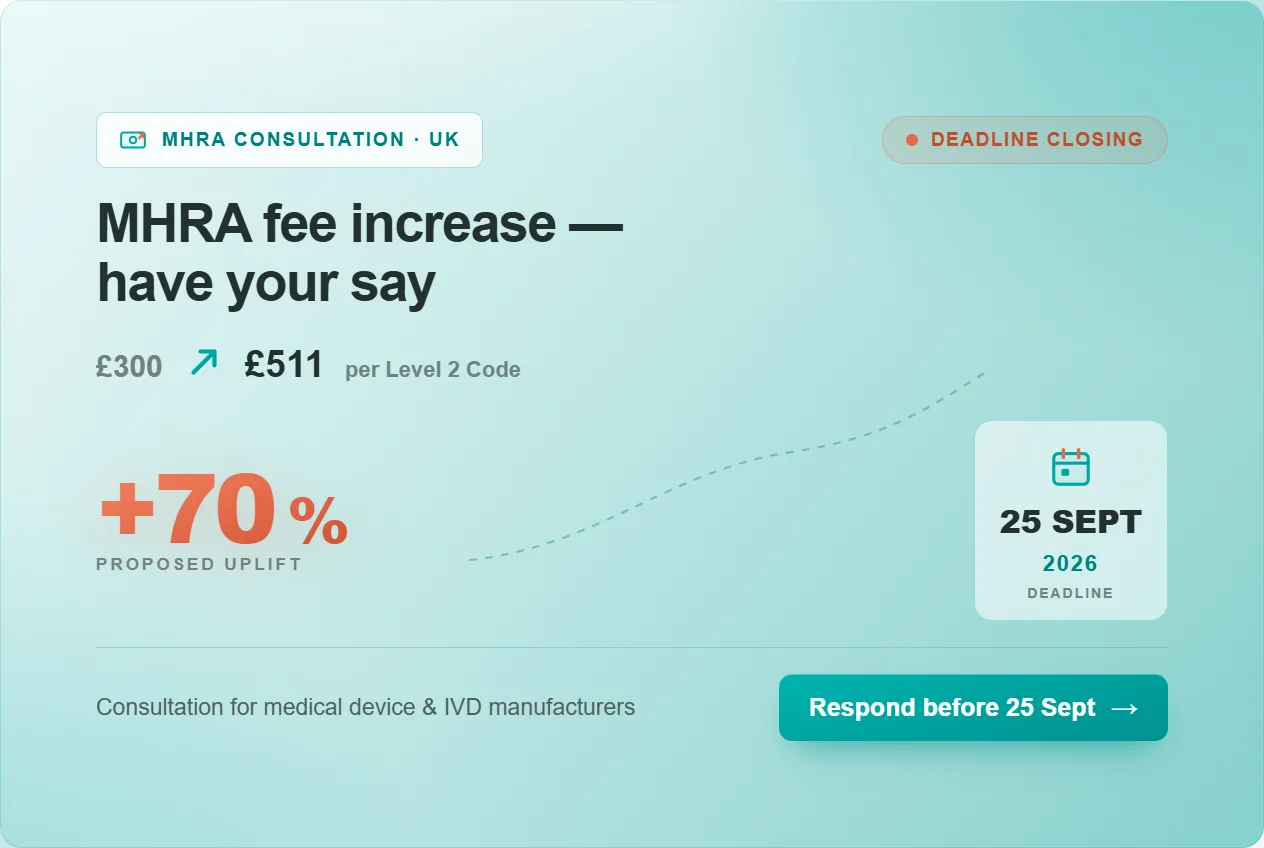
MHRA Consultation 2026: The Fee Increases Coming for Medical Device Manufacturers in 2027
The MHRA has opened a consultation on fee increases from April 2027 — including a proposed 70 % rise in the post-market surveillance fee. Manufacturers have until 25 September to respond.

Well-Established Technologies Under the MDR: EU Commission Expands Exemption List
The EU Commission has expanded the WET list under the MDR, easing requirements for certain class II and class III devices.
Stay Updated
Get the latest regulatory updates and industry insights delivered to your inbox.
Subscribe to Updates