Implications of the Update to the Borderline & Classification Manual under MDR and IVDR
On 12 September 2025, the European Commission published Version 4 of the Manual on Borderline and Classification under Regulations (EU) 2017/745 and 2017/746, developed by the Borderline and Classification Working Group (BCWG). This updated manual provides revised guidance on determining whether a product is a medical device (or in vitro diagnostic device), dealing with borderline cases, and applying the classification rules under MDR and IVDR. Regulatory affairs professionals should be aware of both the new content and the practical implications for compliance.
MedNet EC-REP
Author

What’s New in Version 4
While the update does not rewrite the legislation, it adds clarification, new examples, and refined interpretation. Key growth areas in the manual include:
- More concrete case studies of borderline scenarios. These help illustrate how decisions should be made in context, especially in ambiguous cases where a product might be viewed under several regulatory regimes (e.g. medical devices vs. medicinal products, cosmetics, biocides or PPE).
- Clarification on how intended use and product characteristics interact to drive classification and qualification under MDR / IVDR Articles governing “what is a device.”
- Additional examples addressing innovative and combination products where features may overlap categories.
- Refined guidance on applying risk classification rules (Annex VIII MDR, IVDR) in edge cases. This includes more nuanced interpretation of device functionality, sterility, software, and active substances.
Why this Matters
For regulatory affairs professionals, Version 4 carries significance in several dimensions:
- Reducing Uncertainty in Borderline Cases
Organizations developing products at the margins—e.g. with dual-action elements, or features that could push them into a higher-risk class—will find more useful precedent in Version 4. These precedents could reduce variation in how different competent authorities or notified bodies interpret borderline devices. - Consistency Across EU Member States
Harmonisation is a continuing goal under MDCG and BCWG. Better-defined examples reduce the room for divergent interpretations at the national level, which in turn helps streamline conformity assessment / regulatory strategy. - Impacts on Regulatory Strategy and Product Development
Decisions about how to design a device, choose materials, define claims, or document intended use may be swayed by how the manual treats similar cases. Marketing claims that tilt a product into medicinal or cosmetic territory, or functionality that crosses into IVD scope, will need careful pre-market review in light of the new examples. - Notified Body and Authority Interactions
Notified bodies and regulators may reference the manual in audits, conformity assessment, and when issuing questions. Regulatory dossiers should anticipate queries based on the examples and clarity provided in Version 4. It may alter the expectations for technical documentation, especially in borderline or combination cases.
Practical Recommendations
Regulatory affairs teams should consider the following steps in response to the update:
- Review existing product portfolio for borderline / combination products to see if reclassification risk has shifted. If a device was borderline before, check whether one of the new examples is closely analogous to it.
- Update internal classification decision trees and standard operating procedures to align with the new manual. Ensure that documentation explicitly references the new examples where relevant.
- Train staff (regulatory, R&D, marketing) on how intended use, claims, and product design can affect classification, especially as illustrated in recent cases in the manual.
- For new product development, consult the manual early when drafting claims, specifications, or design features that might trigger reclassification or cross-regulatory-regime risk.
- Maintain dialogue with Notified Bodies or Competent Authorities: include in project planning any time needed to address borderline issues, to avoid downstream surprises in conformity assessment.
Potential Challenges and Areas to Monitor
- Even with the updated manual, some borderline cases will remain ambiguous, especially for novel technologies or combination products.
- It remains necessary to interpret the manual in the specific context of the device, its intended use, the claim, and national authority practice. Regulatory risk may still arise.
- Differences in how certain Member States or Notified Bodies apply the manual may persist until case law or frequent practice builds up.
- Keeping up with related guidance (MDCG, harmonised standards, EU case law) remains essential: the manual does not replace binding law, and other regulations (e.g. medicinal products, cosmetics, biocides) may still apply depending on route of qualification.
Related Articles
IVDR Rule 7: When Is IVD Control Material Class B? (MDCG 2020-16 Rev. 5)
MDCG 2020-16 Rev. 5 clarifies when IVD control material without an assigned value falls under class B, and when another rule applies.
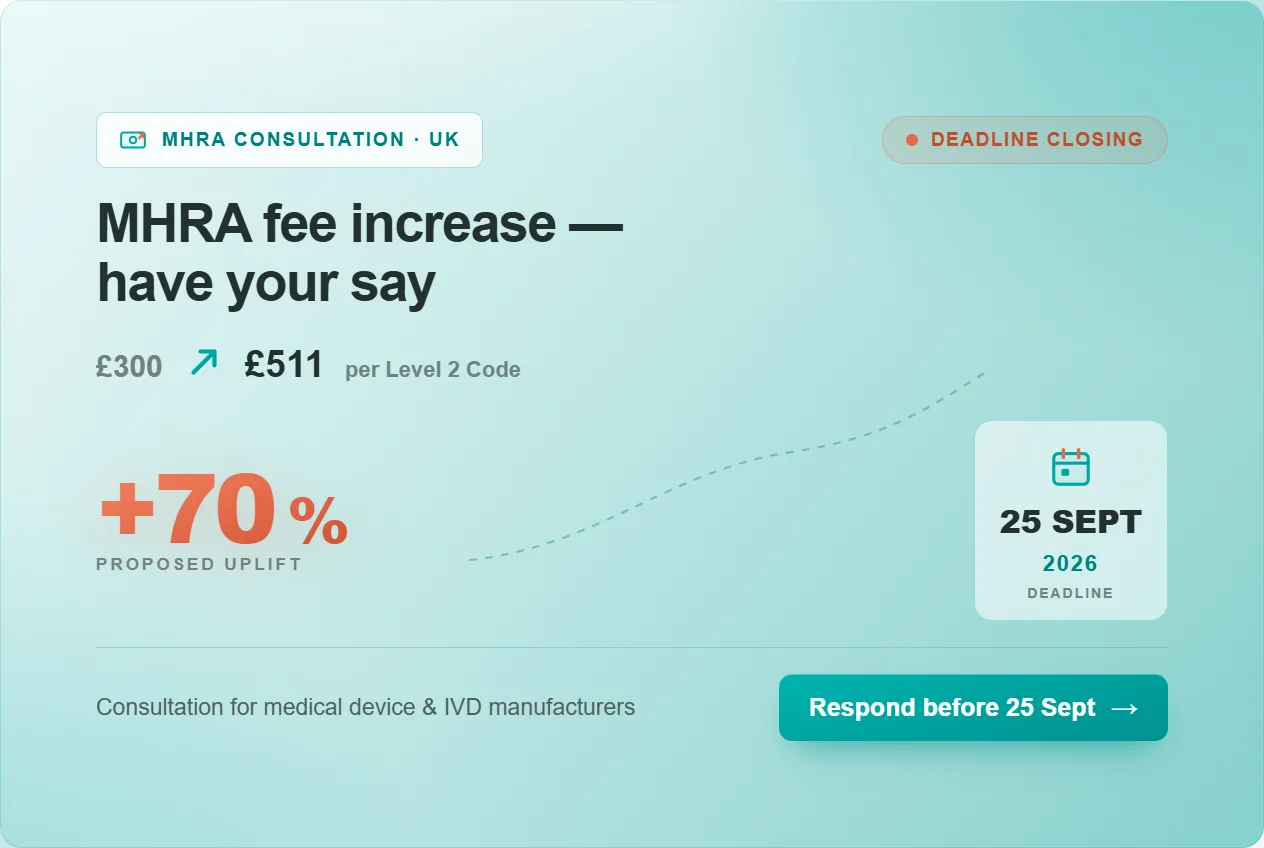
MHRA Consultation 2026: The Fee Increases Coming for Medical Device Manufacturers in 2027
The MHRA has opened a consultation on fee increases from April 2027 — including a proposed 70 % rise in the post-market surveillance fee. Manufacturers have until 25 September to respond.

New EU Study: Where Manufacturers and Authorised Representatives Really Stand on MDR and IVDR
New EU study finds 48% of manufacturers have withdrawn devices from the market. Key MDR/IVDR and AR findings for 2026. Read the numbers now.
Stay Updated
Get the latest regulatory updates and industry insights delivered to your inbox.
Subscribe to Updates