EU Expands eIFU Eligibility: Key Changes under Implementing Regulation (EU) 2025/1234
The EU expands the use of electronic Instructions for Use (eIFU) for professional-use medical devices under Implementing Regulation (EU) 2025/1234. Key compliance considerations for MDR and IVDR manufacturers.
MedNet EC-REP
Author

eIFUs – How to benefit as professional-use device manufacturer?
EU Expands eIFU Eligibility for Professional-Use Devices under Commission Implementing Regulation (EU) 2025/1234
The regulatory framework for electronic Instructions for Use (eIFU) in the European medical device sector continues to evolve. With the adoption of Commission Implementing Regulation (EU) 2025/1234, the European Commission has expanded the categories of medical devices that may provide instructions for use in electronic form (https://eur-lex.europa.eu/eli/reg_impl/2025/1234/oj/eng).
For manufacturers of medical devices and in-vitro diagnostics (IVDs), this amendment to Commission Implementing Regulation (EU) 2021/2226 represents an important step toward digital product documentation, while maintaining the safety principles established under the Medical Device Regulation (EU) 2017/745 and the In Vitro Diagnostic Regulation (EU) 2017/746.
eIFU Remain Limited to Professional-Use Devices
A key regulatory principle remains unchanged: electronic instructions for use may only replace paper instructions for devices intended exclusively for professional users.
Devices intended for lay users, home-use diagnostics, or consumer healthcare applications must continue to include paper instructions for use. Manufacturers must therefore carefully evaluate the intended user group and foreseeable use scenarios during regulatory classification and risk management.
Regulatory Requirements under MDR and IVDR
Both MDR and IVDR define general obligations regarding the information supplied with medical devices and IVDs.
Key provisions include:
- MDR Article 10(11) and Annex I Chapter III, 23
- IVDR Article 10(10) and Annex I Chapter III, 20
These sections require manufacturers to ensure that instructions for use are:
- clear and understandable
- accessible to the intended user
- kept up to date throughout the device lifecycle.
In addition, the norm EN ISO 20417:2021 Medical devices - Information to be supplied by the manufacturer is useful as support for the preparation of the instruction for use.
A Key Advantage: Managing EU Language Requirements
One of the most practical advantages of eIFU is the simplified management of national language requirements across the EU.
Under MDR and IVDR, instructions for use must be provided in the official language(s) required by each Member State where the device is made available. (See EU overview of language requirements https://health.ec.europa.eu/publications/overview-language-requirements-manufacturers-medical-devices_en)
For manufacturers distributing devices in multiple EU markets, this often means maintaining a large number of translated IFU versions.
A compliant eIFU platform enables manufacturers to:
- host all required translations in one central location
- provide immediate access to the correct language version
- update individual translations without reprinting entire manuals.
If all required translations are available electronically, manufacturers can more efficiently meet EU language compliance obligations while avoiding complex logistics related to multilingual printed instructions.
Operational Benefits of eIFU
Beyond language management, eIFU offer several additional advantages for Regulatory Affairs and Quality teams.
Faster safety updates
Electronic IFU allow manufacturers to publish updated instructions immediately after regulatory approval.
Improved document control
Digital platforms support version tracking, traceability, and archived access to previous IFU versions.
Sustainability and logistics efficiency
Reducing printed documentation decreases packaging volume and environmental impact.
Key Compliance Considerations
Despite these benefits, manufacturers must address several regulatory requirements.
Risk Assessment
The manufacturer must perform a documented risk assessment to show that providing IFUs electronically maintains or improves safety compared with paper.
Availability and Access
- eIFUs must be available in all EU Member States where the device is placed on the market, unless justified otherwise in the risk assessment.
- They must be accessible on a website or electronic medium and provided in a commonly used format that can be read with freely available software.
Website Requirements
Websites used to host eIFUs must meet the following conditions:
- Protected against unauthorized access and tampering.
- Stable internet address, directly accessible.
- Must fulfil data protection requirements (GDPR).
- Ensure minimal server downtime and display errors.
Request for Paper Version
Even if IFUs are delivered electronically, manufacturers must have a system to provide a paper version at no extra cost upon user request, normally within 7 calendar days of request.
Labeling
Manufacturers must clearly indicate on the device label or packaging that instructions are supplied electronically and provide information on how to access them.
Retention and Versions
eIFUs must be retained in electronic form for specified periods after the device is last placed on the market:
- 10 years for devices with a defined expiry date (except implantable).
- 15 years for implantable devices or devices without a defined expiry date.
Historical versions (including publication dates) must be accessible on the website or, if obsolete, available on request.
Connection to UDI and Eudamed
Once Eudamed’s UDI database registration becomes mandatory, the manufacturer must provide the internet address (URL) where the eIFU is accessible to the database.
Conclusion
The updated EU eIFU framework expands opportunities for digital instructions for use across the medical device sector. However, manufacturers must ensure strict compliance with regulatory conditions—particularly the requirement that eIFU replacing paper instructions are only permitted for devices intended exclusively for professional users.
When implemented correctly, eIFU not only support regulatory compliance under MDR and IVDR but also provide a significant advantage in managing multilingual documentation across the European market.
Related Articles
IVDR Rule 7: When Is IVD Control Material Class B? (MDCG 2020-16 Rev. 5)
MDCG 2020-16 Rev. 5 clarifies when IVD control material without an assigned value falls under class B, and when another rule applies.
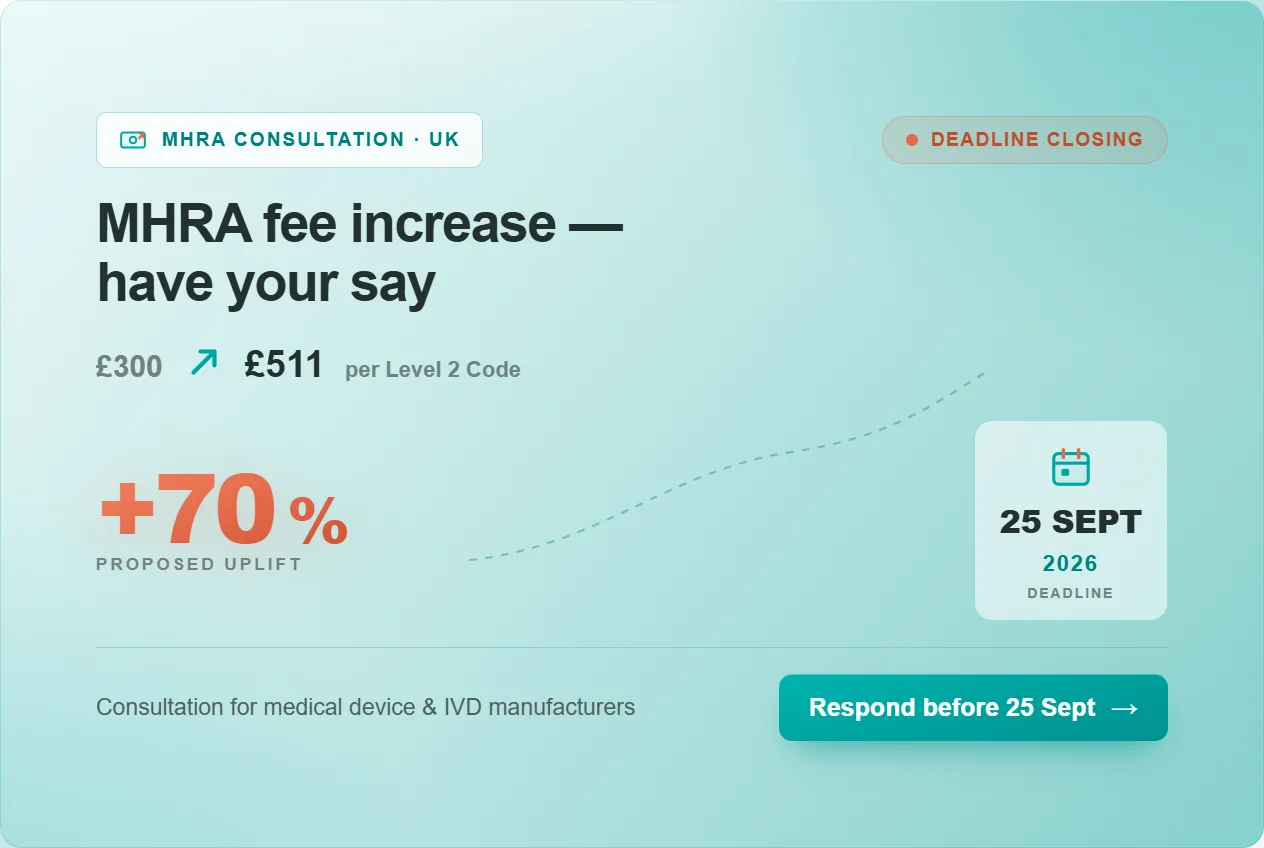
MHRA Consultation 2026: The Fee Increases Coming for Medical Device Manufacturers in 2027
The MHRA has opened a consultation on fee increases from April 2027 — including a proposed 70 % rise in the post-market surveillance fee. Manufacturers have until 25 September to respond.

New EU Study: Where Manufacturers and Authorised Representatives Really Stand on MDR and IVDR
New EU study finds 48% of manufacturers have withdrawn devices from the market. Key MDR/IVDR and AR findings for 2026. Read the numbers now.
Stay Updated
Get the latest regulatory updates and industry insights delivered to your inbox.
Subscribe to Updates